
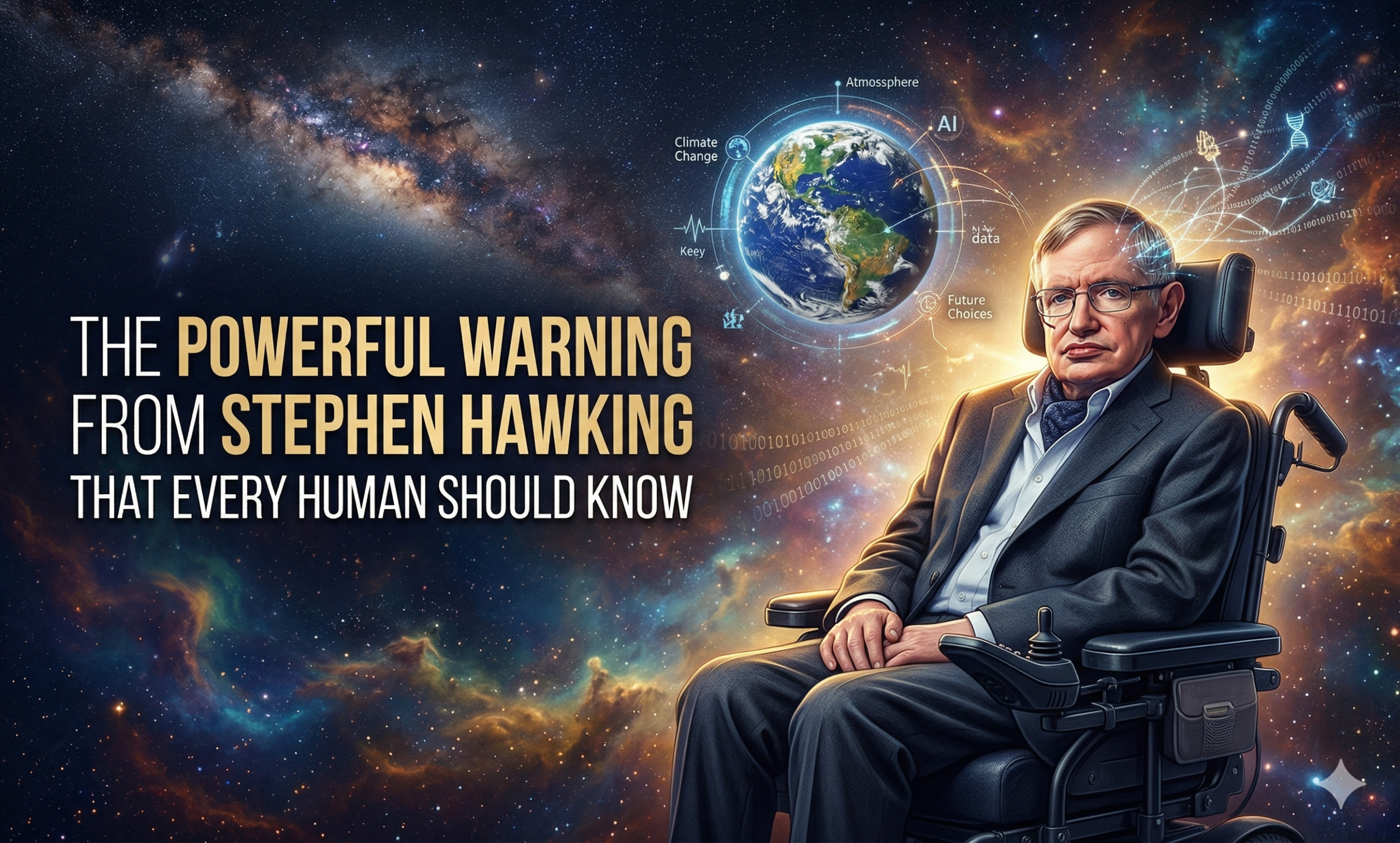
Powerful Warning from Stephen Hawking: Renowned theoretical physicist Stephen Hawking once delivered a striking warning about the long-term future of human civilization. According to him, if humanity continues to live solely on Earth, the chances of surviving the next thousand years could be extremely slim. His statement sparked global discussion about the risks facing our planet and the importance of preparing for the future.
Hawking’s message was not intended to spread fear or pessimism. Instead, it was meant to encourage humanity to think long term, invest in scientific innovation, and explore the possibility of living beyond Earth. By addressing global threats and advancing technology, humanity may increase its chances of surviving and thriving far into the future.

This article explores Hawking’s warning, the potential dangers facing civilization, and why scientists believe expanding into space may be critical for the survival of our species.
The Legacy of Stephen Hawking

Stephen Hawking was one of the most respected scientists of the modern era. His research in cosmology and theoretical physics helped reshape our understanding of the universe.
Hawking made significant contributions to the study of black holes, the origins of the universe, and the relationship between gravity and quantum mechanics. Despite being diagnosed with a motor neuron disease (ALS) at a young age, he continued to conduct groundbreaking research for decades.

His ability to explain complex scientific concepts in simple terms made him a global icon of science. His famous book A Brief History of Time introduced millions of readers to the mysteries of the cosmos.
Hawking’s Warning About Humanity’s Future
In several lectures and interviews, Hawking suggested that humanity faces serious long-term risks. In essence, he believed that if humans remain limited to a single planet, the survival of civilization over the next millennium becomes uncertain.
This statement was based on scientific reasoning and observations about the many challenges humanity faces today.

Hawking argued that developing the ability to live beyond Earth could act as a safeguard for our species. Establishing human settlements in space could help ensure that civilization continues even if catastrophic events occur on our home planet.
Major Threats That Could Endanger Human Civilization
Hawking highlighted several potential threats that could put the future of humanity at risk. These dangers include environmental problems, technological risks, and natural disasters.
Climate Change and Environmental Decline
One of the most pressing challenges facing humanity is climate change. Rising global temperatures, extreme weather events, and the destruction of ecosystems are already affecting many regions around the world.
Human activities such as burning fossil fuels and deforestation contribute to increasing levels of greenhouse gases in the atmosphere. If these trends continue, they could lead to severe consequences such as food shortages, water scarcity, and widespread environmental disruption.
Hawking emphasized the need for global cooperation to protect the environment and reduce the impact of climate change.
The Threat of Nuclear War
Another concern raised by Hawking was the danger of nuclear conflict. Modern nuclear weapons possess destructive power capable of causing massive devastation.
A large-scale nuclear war could lead to catastrophic loss of life and long-term environmental damage. Scientists have also warned about the possibility of a “nuclear winter,” a scenario in which smoke and debris block sunlight, leading to global cooling and agricultural collapse.
Such an event could severely threaten human civilization.
Artificial Intelligence and Technological Risks
Hawking also warned about the rapid advancement of artificial intelligence. While AI has the potential to improve many aspects of life, it also raises concerns if its development is not carefully managed.
Advanced AI systems could eventually surpass human intelligence. Without proper safeguards, these technologies could behave unpredictably or operate outside human control.
Hawking believed that governments, scientists, and technology companies must work together to ensure that AI remains beneficial and safe for humanity.
Asteroids and Cosmic Threats
Earth has experienced several major asteroid impacts throughout its history. One of the most well-known events occurred about 66 million years ago when a massive asteroid struck the planet, leading to the extinction of the dinosaurs.
Although large asteroid impacts are rare, they remain a potential risk. A sufficiently large asteroid could cause global devastation.
To reduce this risk, scientists track near-Earth objects and develop strategies for planetary defense.
Pandemics and Biological Dangers
Another potential threat to humanity is the spread of dangerous diseases. Global travel and population growth allow diseases to spread rapidly across continents.
In addition, advances in biotechnology have raised concerns about accidental or deliberate misuse of biological research.
Hawking stressed the importance of international cooperation, scientific research, and strong public health systems to prevent and manage global pandemics.
The Role of Space Exploration in Humanity’s Survival
Hawking believed that expanding beyond Earth could significantly improve humanity’s long-term chances of survival.
If humans establish permanent settlements on other planets or moons, our species would no longer depend on a single planet for survival.
In such a scenario, even if Earth experiences a catastrophic event, human civilization could continue elsewhere.
The Possibility of Colonizing Mars

Among the potential destinations for human settlement, Mars is often considered the most promising.
Mars shares several similarities with Earth, including a similar day length and evidence that water once existed on its surface. Scientists are exploring ways to build habitats, grow food, and produce oxygen on the planet.
Research missions continue to study Mars to determine whether it could support human life in the future.
Challenges of Living on Other Worlds
Although the idea of colonizing another planet is exciting, it also presents enormous challenges.
Mars and other celestial bodies have harsh environments that are very different from Earth. Some of the major challenges include:
- Extreme temperatures
- Thin or nonexistent atmospheres
- High radiation exposure
- Limited resources
Overcoming these obstacles will require significant technological innovation and scientific research.

Hawking’s Message as a Call for Progress
Hawking’s warning was ultimately a call to action rather than a prediction of doom.
He believed humanity has the intelligence and creativity necessary to overcome global challenges. However, progress requires dedication to science, education, and cooperation.
By investing in research and technological development, humanity can address global risks and expand its horizons.
Scientific Progress Since Hawking’s Statement
Since Hawking shared his concerns, many advancements have been made in science and technology.
New Developments in Space Exploration
Space exploration has entered an exciting new era. Governments and private companies are developing advanced spacecraft and planning missions to the Moon and Mars.
Reusable rockets and new propulsion technologies are making space travel more accessible and cost-effective.
These developments bring humanity closer to the possibility of living beyond Earth.
Growing Awareness of Climate Change
Public awareness about climate change has increased significantly in recent years. Many countries are investing in renewable energy sources such as solar and wind power.
International agreements and environmental initiatives aim to reduce carbon emissions and protect natural ecosystems.
Planetary Defense Research
Scientists are also working on strategies to protect Earth from potential asteroid impacts.
Space missions have already tested methods for altering the path of small asteroids, demonstrating that planetary defense technologies could be developed in the future.
The Importance of Global Collaboration
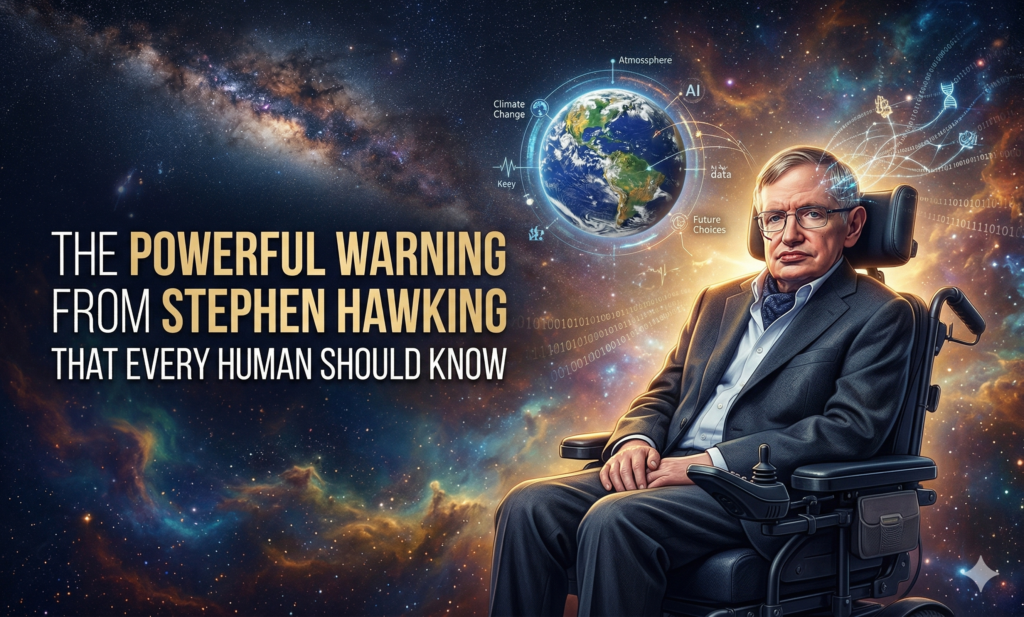
Hawking believed that humanity’s greatest challenges require global cooperation.
Issues like climate change, pandemics, and technological risks affect the entire planet. No single country can solve these problems alone.
By sharing knowledge, resources, and scientific expertise, nations can work together to create solutions that benefit humanity as a whole.
The Power of Human Innovation
Throughout history, humanity has overcome numerous obstacles through innovation and determination.
Scientific discoveries, technological breakthroughs, and educational advancements continue to expand our understanding of the universe and our ability to solve complex problems.
Investing in research and encouraging curiosity will play a crucial role in shaping the future of our species.
The Future of Humanity
Stephen Hawking’s warning encourages us to think about the long-term future of civilization.
The survival of humanity over the next thousand years will depend on the choices we make today. Protecting the environment, managing technological risks, and exploring new frontiers are all part of building a secure future.
Hawking believed that humanity’s curiosity and desire to explore the universe are among our greatest strengths.
Conclusion
Stephen Hawking’s statement that humanity might struggle to survive the next thousand years captured global attention because it raised important questions about the future of our species.
Rather than predicting disaster, Hawking aimed to inspire action. His message encouraged humanity to address global challenges, advance scientific research, and explore opportunities beyond Earth.
By working together and embracing innovation, humanity can overcome obstacles and create a future that extends far beyond our home planet.
The path forward may be challenging, but with knowledge, cooperation, and determination, humanity has the potential to thrive for thousands of years to come.
FAQs
1. Why did Stephen Hawking believe humanity might not survive the next 1,000 years?
Stephen Hawking believed that several global threats—such as climate change, nuclear conflict, artificial intelligence risks, pandemics, and asteroid impacts—could threaten human civilization over long periods if they are not properly managed.
2. Did Stephen Hawking predict the end of humanity?
No, Stephen Hawking did not make a definite prediction about humanity’s extinction. His statement was more of a warning meant to encourage scientific progress, global cooperation, and space exploration to reduce potential risks.
3. Why did Hawking emphasize space exploration for human survival?
Hawking believed that becoming a multi-planetary species would improve humanity’s chances of survival. If humans establish colonies on other planets, civilization could continue even if a major catastrophe occurs on Earth.