
Introduction
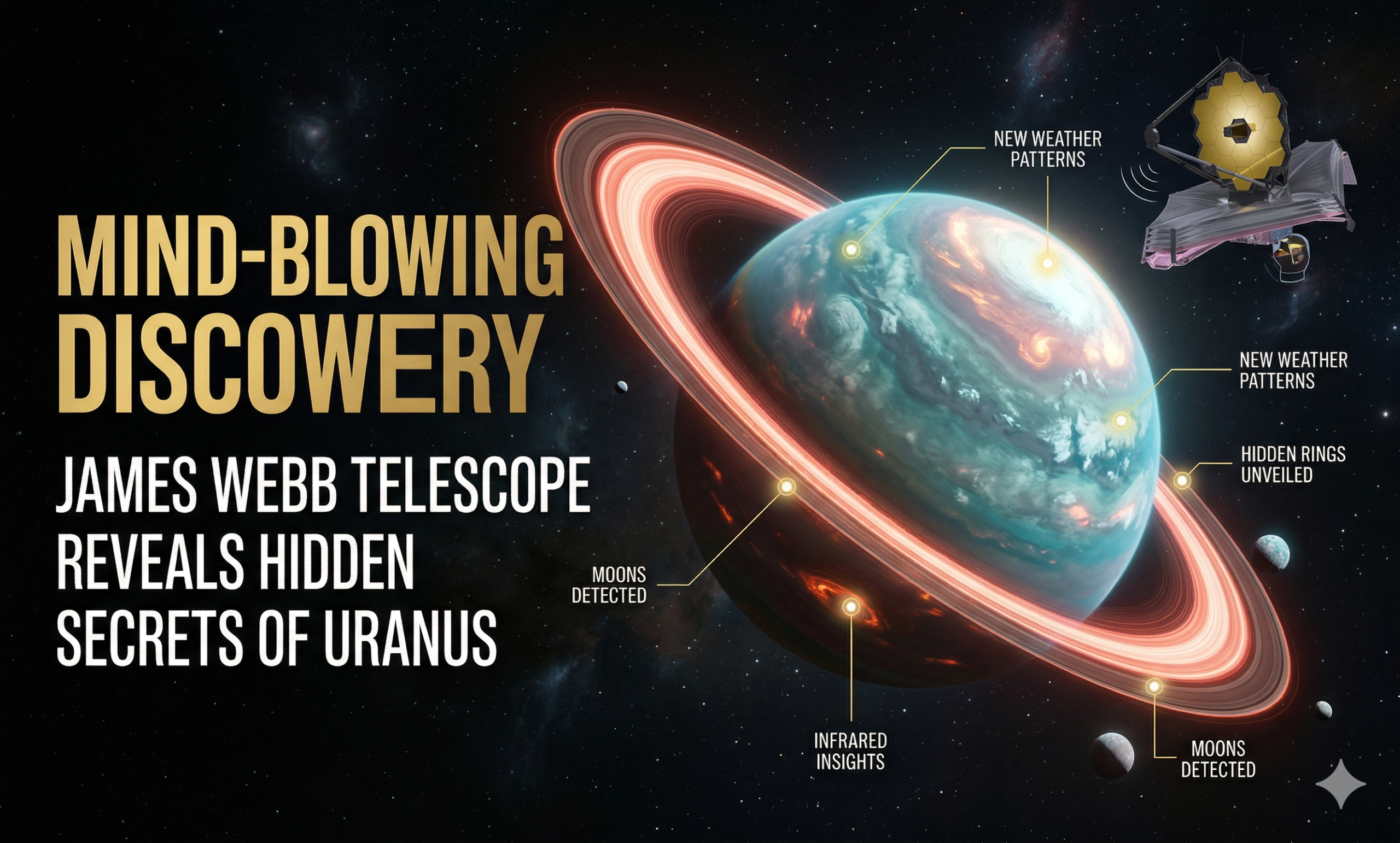
Mind-Blowing Discovery: The distant ice giant Uranus has long been one of the most mysterious planets in our solar system. Discovered in 1781 by William Herschel, the planet has puzzled astronomers for centuries due to its unusual tilt, icy atmosphere, faint rings, and complex moons.
For decades, scientists had limited data about Uranus because only one spacecraft, Voyager 2, has ever visited the planet. While the mission revealed important details, much of Uranus remained hidden behind its cold and hazy atmosphere.

Everything changed when the powerful James Webb Space Telescope began observing the outer planets. Equipped with advanced infrared instruments, the telescope is capable of seeing features never detected before.
Recent observations have revealed astonishing new information about Uranus’ rings, atmosphere, storms, and magnetic environment. These discoveries are transforming our understanding of this distant world and providing new clues about how planets form and evolve.
This article explores the shocking secrets uncovered by the James Webb Space Telescope and why they are reshaping planetary science.
Understanding Uranus: The Solar System’s Most Unusual Planet
A Planet That Rotates on Its Side

One of the most unusual features of Uranus is its extreme axial tilt. Unlike most planets that rotate upright, Uranus rotates almost completely sideways.
Its axis is tilted about 98 degrees, meaning the planet essentially rolls around the Sun like a giant ball.
This unusual orientation causes extreme seasons:
- Each pole experiences 42 years of sunlight
- Followed by 42 years of darkness

Scientists believe this tilt may have been caused by a massive collision early in the solar system’s history.
Why Uranus Is Called an Ice Giant
Uranus belongs to a special class of planets called ice giants, along with Neptune.
Unlike gas giants like Jupiter and Saturn, ice giants contain larger amounts of icy materials such as:
- Water
- Ammonia
- Methane
Methane in the atmosphere absorbs red light, which gives Uranus its distinctive blue-green color.
The Revolutionary Power of the James Webb Space Telescope
A New Era of Space Observation
The James Webb Space Telescope represents the most powerful space observatory ever built.
It was launched in 2021 through a collaboration between:
- NASA
- European Space Agency
- Canadian Space Agency
The telescope operates primarily in the infrared spectrum, allowing it to observe objects hidden by dust, gas, and cold temperatures.
This capability makes it ideal for studying distant planets like Uranus.
Why Webb Is Perfect for Studying Uranus
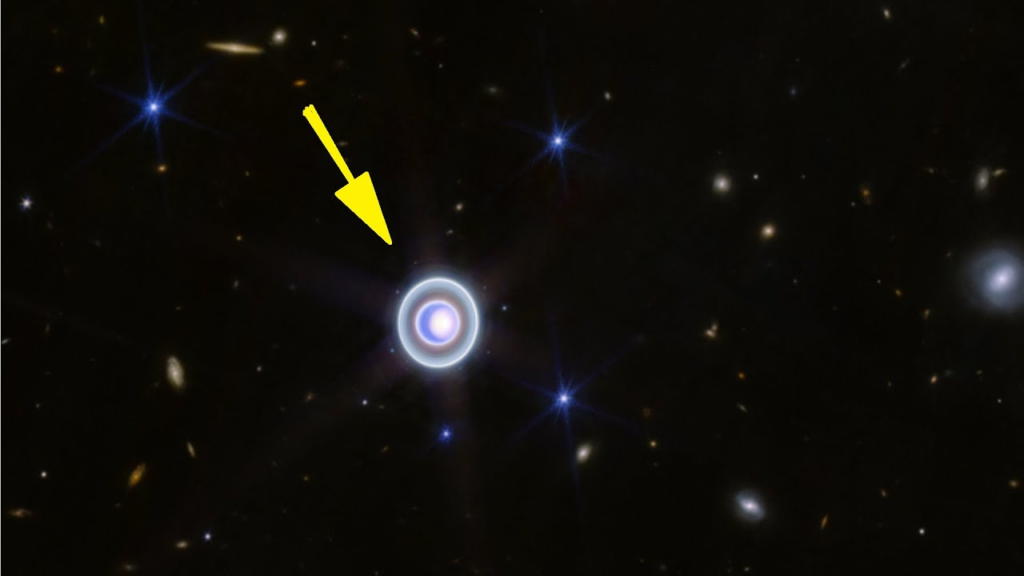
Uranus lies about 2.9 billion kilometers from the Sun, making it difficult to study using traditional telescopes.
The James Webb telescope offers several advantages:
- Extremely high sensitivity
- Advanced infrared imaging
- Ability to detect faint atmospheric features
- Capability to observe distant planetary rings
With Webb, scientists can now see details that were invisible before.
Stunning New Images of Uranus
Revealing the Planet’s Hidden Rings
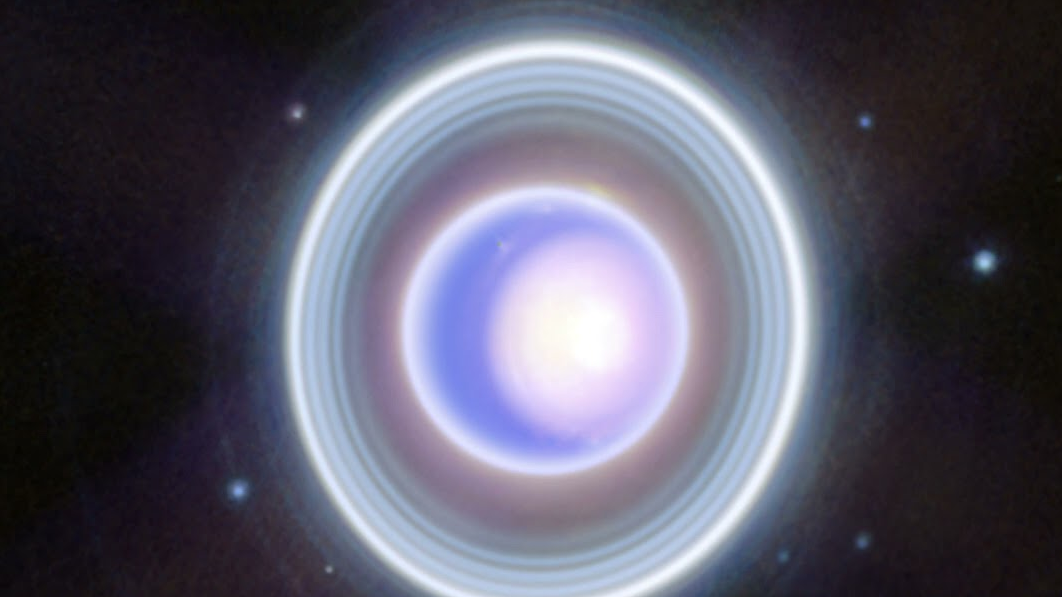
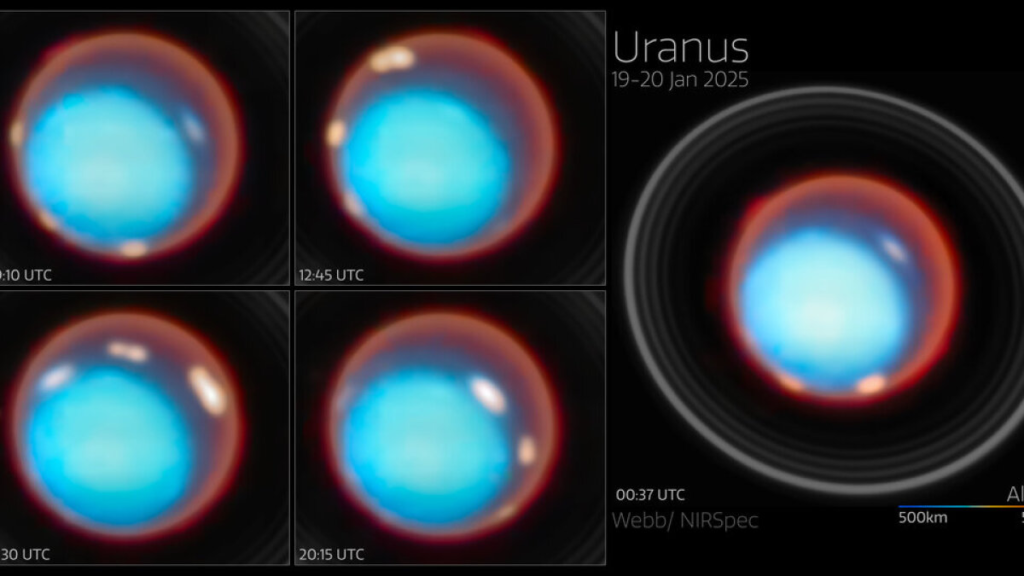
One of the most striking discoveries from Webb observations is the clarity of Uranus’ ring system.
Uranus has 13 known rings, but most are extremely faint and difficult to detect.
Webb’s powerful instruments revealed:
- Bright inner rings
- Dust rings extending farther than previously known
- Subtle ring structures never seen before
These findings suggest the ring system may be more complex than scientists originally believed.
Detecting New Atmospheric Storms
For many years, Uranus appeared relatively calm compared to other giant planets.
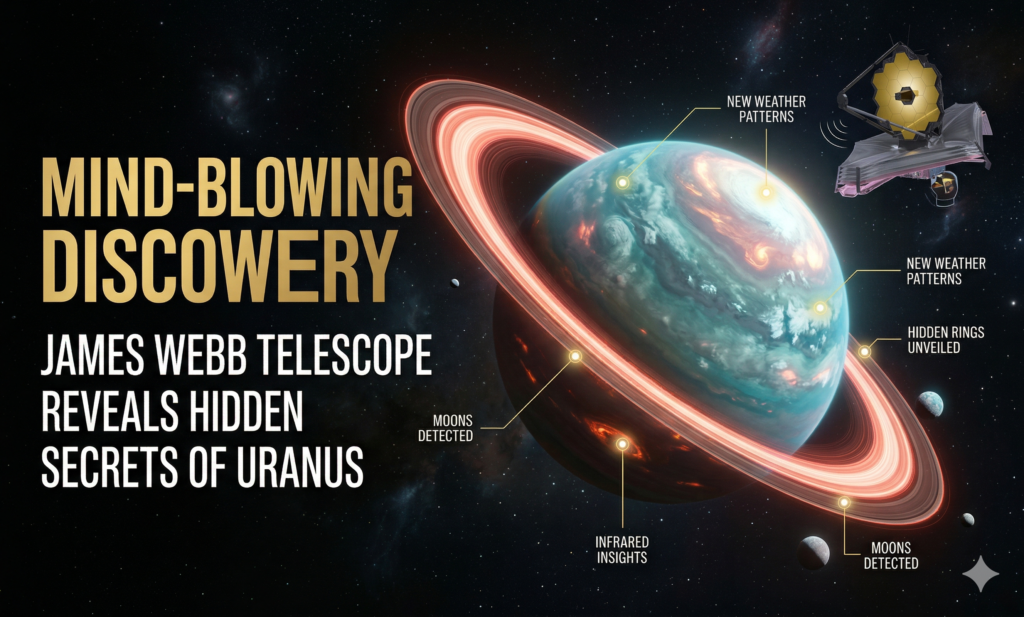
However, Webb observations have revealed bright atmospheric storms and cloud formations.
These features indicate that the planet’s atmosphere is far more dynamic than previously thought.
Scientists observed:
- Large cloud systems
- High-altitude methane clouds
- Bright storm features near the poles
These discoveries suggest that Uranus may experience powerful weather patterns.
The Mystery of Uranus’ Polar Cap
A Bright Polar Feature
One of the most surprising observations made by Webb is the detection of a bright polar cap.
The cap appears as a glowing region near one of the planet’s poles.
Scientists believe this phenomenon may be linked to:
- Seasonal sunlight exposure
- Changes in atmospheric circulation
- Methane cloud formation
As Uranus approaches a seasonal transition, the polar region could undergo dramatic changes.
Uranus’ Moons Revealed in Greater Detail
The Major Moons of Uranus
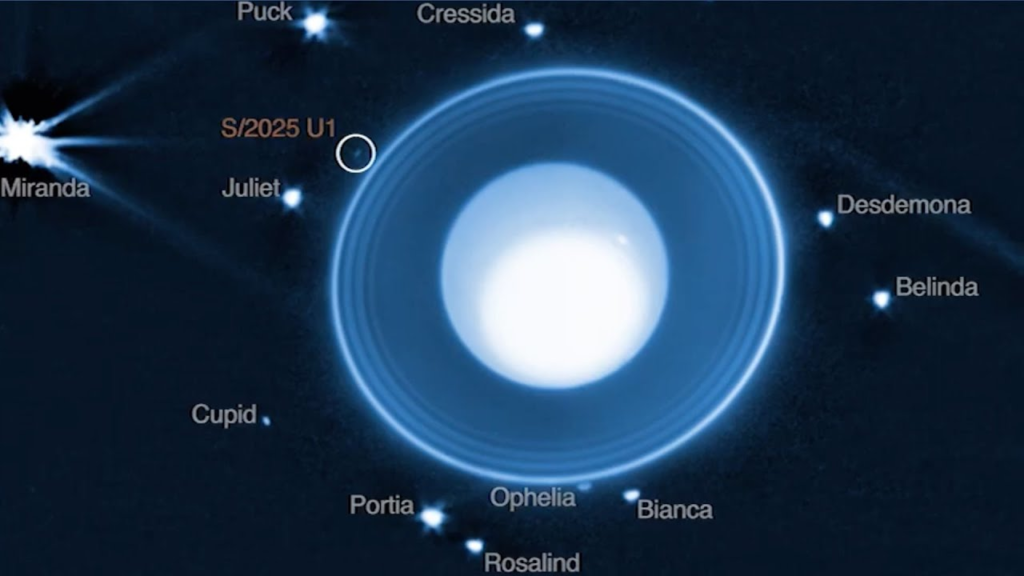
Uranus has 27 known moons, many of which are named after characters from works by William Shakespeare and Alexander Pope.
Some of the most notable moons include:
- Titania
- Oberon
- Umbriel
- Ariel
- Miranda
Webb observations captured several of these moons in extraordinary clarity.
Possible Hidden Activity on the Moons
Scientists are particularly interested in whether Uranus’ moons could contain subsurface oceans.
Some moons show signs of geological activity, including:
- Surface fractures
- Ice flows
- Possible cryovolcanism
If confirmed, these moons could become important targets for future space missions.
The Strange Magnetic Field of Uranus
One of the Weirdest Magnetic Fields in the Solar System
Uranus has a magnetic field unlike any other planet.
Instead of being aligned with its rotation axis, the magnetic field is tilted dramatically and offset from the planet’s center.
This unusual configuration creates a chaotic magnetosphere.
How Webb Helps Study the Magnetosphere
Although Webb does not directly measure magnetic fields, its observations of atmospheric activity and auroras help scientists understand how Uranus interacts with solar radiation.
Studying these interactions may reveal new information about the planet’s internal structure.
What These Discoveries Mean for Planetary Science
Clues About Planet Formation
Studying Uranus helps scientists understand how planets form and evolve.
Ice giants may represent one of the most common types of planets in the universe.
Many exoplanets discovered in other star systems are similar in size to Uranus and Neptune.
Understanding Uranus could therefore help astronomers interpret distant worlds.
Improving Climate Models for Giant Planets
Webb’s observations are also helping scientists improve climate models for gas and ice giants.
By studying atmospheric dynamics on Uranus, researchers can learn more about:
- Planetary weather systems
- Heat transport in planetary atmospheres
- Seasonal changes on giant planets
These insights are valuable for studying both our solar system and distant exoplanets.
The Possibility of Future Missions to Uranus
Why Scientists Want to Return to Uranus
Since the flyby of Voyager 2, scientists have been eager to send another spacecraft to Uranus.
A dedicated mission could explore:
- The planet’s interior
- Its complex magnetosphere
- Its moons and rings
- Atmospheric composition
Proposed Uranus Orbiter Missions
Scientists have proposed several future missions that could orbit Uranus and study the planet in detail.
Such missions could launch in the 2030s and arrive at Uranus in the 2040s.
If approved, these missions would revolutionize our understanding of ice giants.
Why Uranus Still Holds Many Secrets
Despite the discoveries made by the James Webb Space Telescope, Uranus remains one of the least understood planets in the solar system.
Major unanswered questions include:
- What caused Uranus’ extreme tilt?
- How deep are its atmospheric storms?
- Do its moons contain oceans?
- What drives its unusual magnetic field?
Answering these questions will require continued observation and future space missions.
Conclusion
The powerful James Webb Space Telescope has opened a new window into the distant world of Uranus.
Its observations have revealed stunning new details about the planet’s rings, storms, polar regions, and moons. These discoveries are reshaping our understanding of one of the solar system’s most mysterious planets.
For decades, Uranus remained largely unexplored, with only a brief visit from Voyager 2. Now, advanced telescopes are uncovering secrets that were once hidden in the darkness of the outer solar system.
As scientists continue studying the planet with Webb and future missions, Uranus may reveal even more surprising secrets—helping humanity better understand not only our own solar system but also the countless planetary systems scattered throughout the universe.
FAQs
1. What new discoveries has the James Webb Space Telescope made about Uranus?
The James Webb Space Telescope has revealed several new details about Uranus, including clearer images of its faint rings, bright atmospheric storms, a glowing polar cap, and improved views of some of its moons. These discoveries provide scientists with valuable information about the planet’s atmosphere, seasonal changes, and ring structure.
2. Why is Uranus considered one of the most unusual planets in the solar system?
Uranus is unique because it rotates on its side with an axial tilt of about 98 degrees. This extreme tilt causes unusual seasons where each pole experiences around 42 years of sunlight followed by 42 years of darkness. Its strange magnetic field and icy composition also make it different from other planets.
3. What makes the James Webb Space Telescope so powerful?
The James Webb Space Telescope observes the universe primarily in infrared light, allowing it to detect objects that are extremely distant, cold, or hidden by dust and gas. This capability makes it ideal for studying distant planets like Uranus and exploring features that previous telescopes could not see.